Design study / Reverse engineering
Remote Holder
Remotes of different shapes, and a side table they were always loose on. Scanning both the remotes and the table gave me the geometry for a holder that fits all of it.
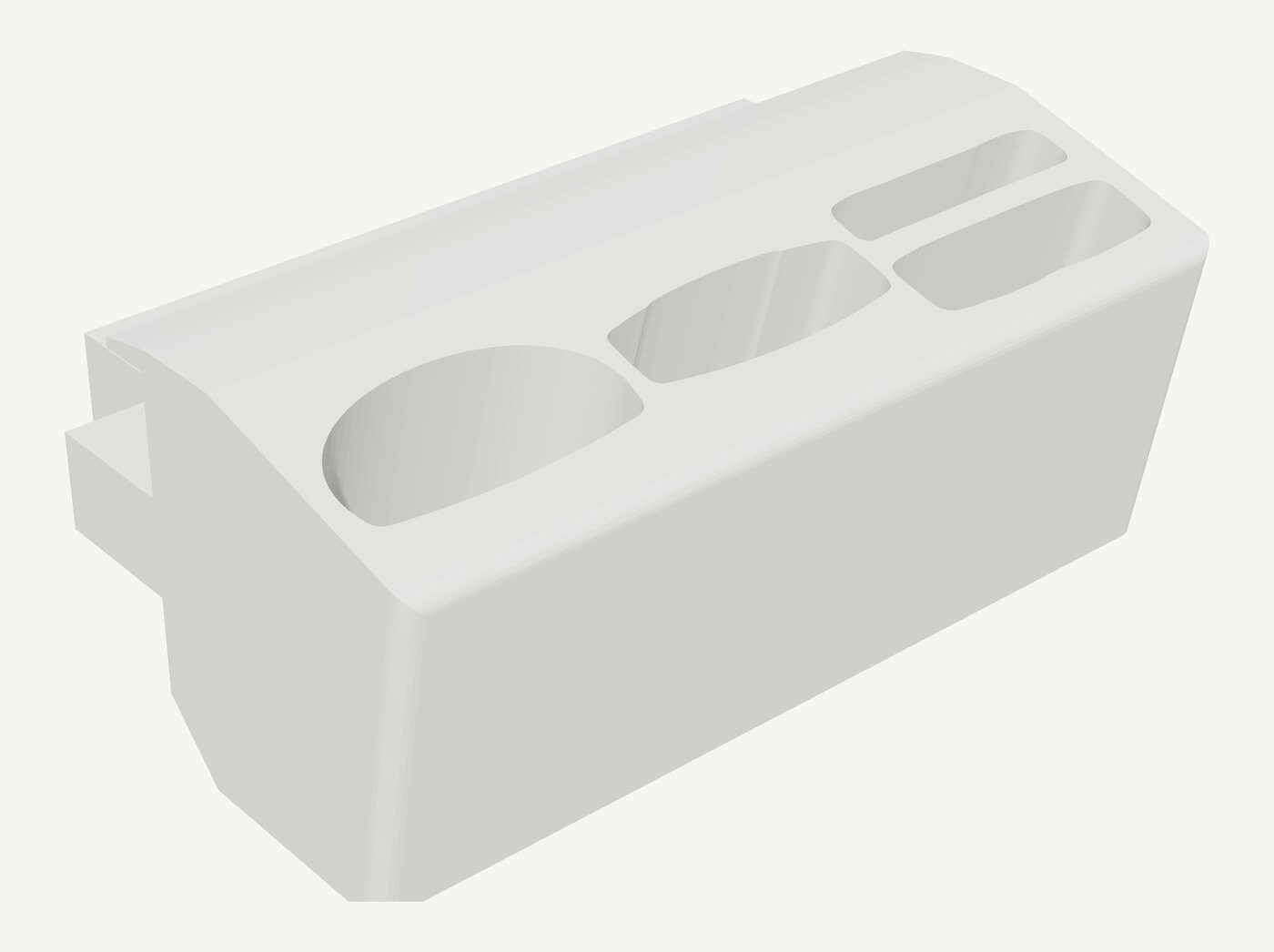
Different shapes, one holder
No two of the remotes share a shape. Anything generic enough to hold all of them would hold none of them properly.
That made it a fitment problem rather than a styling one, and fitment problems are answered by capturing the real geometry rather than guessing at it.
- Process
- 3D scanning, mesh cleanup, CAD, 3D printing
- Scanner
- Revopoint POP 4, turntable and global markers
- Scanned
- Each remote, and the side table it sits on
- Result
- A single holder with a pocket per remote
01 / Capture
Two scans doing two different jobs
Every dimension in the holder came off a scan. I scanned each remote to get its outline and depth, and separately scanned the side table to get the surface the holder would sit on. The remotes define the pockets. The table defines the base.
Scanning the environment rather than only the object is the part that made this different from the vacuum dock. A part can fit its contents perfectly and still sit badly where it lives.
02 / Test the fit first
One pocket before all of them
Before committing to the full body I modelled a flat test coupon carrying a single pocket, so a wrong clearance would cost one small print instead of the whole holder.
The coupon is 102 by 57 by 24 mm, which is enough material around the pocket to check the fit without printing anything that has to look like the final part.
03 / The holder
A pocket shaped to each remote
The finished body is 140 by 97 by 62 mm, with a pocket cut to the shape of each remote.